
Document management is a term that gets used a lot.
But for many New Zealand organisations, it still means very different things.
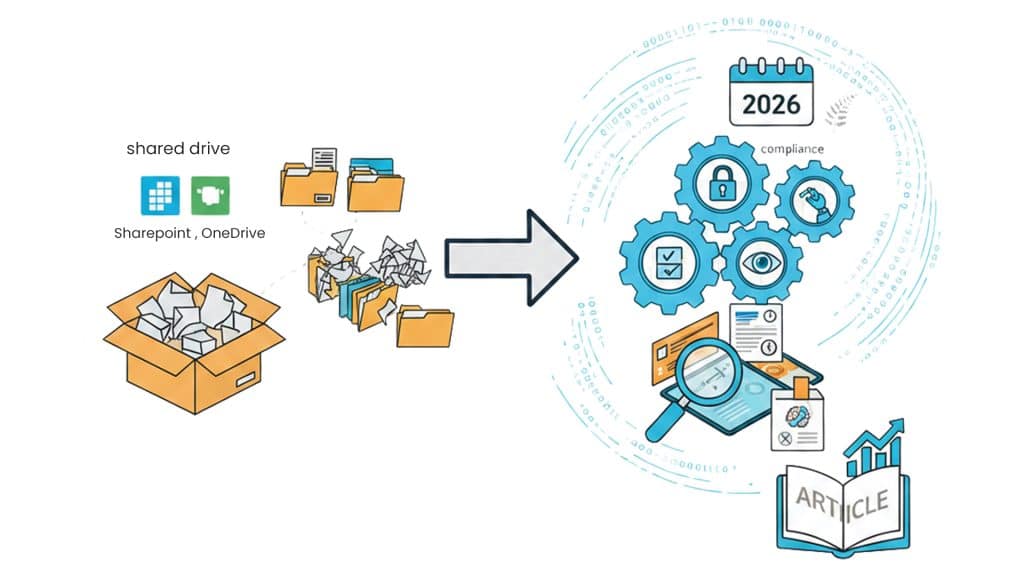
For some, document management is a shared drive.
For others, it is SharePoint, OneDrive, or a collection of folders that grew over time.
In reality, true document management goes far beyond storage.
In 2026, document management in New Zealand is about control, compliance, visibility, and automation. It is about making sure documents are easy to find, correctly managed, and retained for the right amount of time without relying on staff memory.
This article breaks down what document management really means today, why it matters more than ever in New Zealand, and how modern organisations are approaching it.

At its core, document management is the structured way an organisation creates, stores, manages, secures, and controls documents throughout their entire lifecycle.
That lifecycle includes:
True document management is not just about where a file lives. It is about how that file is governed from day one to the end of its required life.
This distinction is critical for NZ organisations operating under increasing regulatory and compliance pressure.

New Zealand businesses, councils, and government agencies face unique challenges.
These include:
Without proper document management, organisations quickly lose visibility over where information lives and who owns it.
It is not uncommon for:
Modern document management solves these problems by removing reliance on individuals and replacing it with consistent system driven control.

Leading document management platforms, including M-Files, rely heavily on metadata to organise and control information.
For example:
Instead of relying on folder names, metadata allows documents to be found, managed, and governed automatically.
This approach is especially powerful in environments like councils, engineering firms, law firms, and utilities where document volumes are high and compliance rules are strict.
When metadata driven document management is implemented through systems such as M-Files, it removes guesswork and reduces human error.

Compliance is one of the main reasons organisations invest in document management.
In New Zealand, many documents must be kept for specific timeframes. Some records must be retained for years or even decades.
Without proper document management:
A modern document management system automates retention and disposal rules. Documents are managed according to policy, not personal judgement.
This significantly reduces risk while also making life easier for staff.

Beyond compliance, document management has a direct impact on productivity.
When documents are easy to find, clearly classified, and always up to date, staff spend less time searching and more time doing valuable work.
Key productivity benefits include:
For NZ organisations dealing with complex projects or distributed teams, this efficiency adds up quickly.

Folder based systems worked when organisations were smaller and document volumes were low.
In 2026, they struggle to keep up.
Common issues include:
Advanced document management platforms, such as M-Files, remove the need for rigid folder structures by allowing documents to exist in multiple contexts through metadata.
This makes information easier to manage as organisations grow and change.
Document management in 2026 is about clarity and confidence.
Confidence that documents are where they should be.
Confidence that compliance requirements are being met.
Confidence that staff can find what they need when they need it.
For New Zealand organisations navigating increasing complexity, modern document management is no longer optional. It is a critical part of running a resilient and compliant operation.
If you are exploring how document management could work for your organisation, the friendly DocSmart team is always happy to have an initial conversation and help you understand your options.
What is document management?
Document management is the structured process of creating, storing, managing, and controlling documents throughout their lifecycle.
Why is document management important in New Zealand?
NZ organisations face specific compliance, privacy, and record keeping obligations that require consistent document control.
Is document management the same as document storage?
No. Storage focuses on where files live. Document management focuses on control, compliance, and lifecycle management.
Who needs document management the most?
Organisations with high document volumes, compliance requirements, or complex workflows benefit the most.
Can document management work with Microsoft 365?
Yes, many document management systems used in New Zealand, including M-Files, are designed to integrate seamlessly with Microsoft 365, SharePoint, Teams, and line of business applications.

© 2026 DocSmart All Rights Reserved l Privacy Policy | Terms & Conditions | Web Design by Virtual Innovation