
Some information challenges don’t arrive gradually. They arrive all at once, in a way that makes the status quo impossible to defend. For Vanuatu’s Ministry of Lands & Natural Resources, two separate events combined to create exactly that kind of moment. A major cyberattack in 2022 shook staff confidence in digital systems. A significant earthquake in 2024 displaced the Ministry and its physical records, leaving thousands of land documents packed into plastic storage boxes.
The central question became unavoidable: how can a government organisation do more with less, without simply asking its people to work harder? That’s the question DocSmart and M-Files have been helping to answer, and it’s a story worth telling properly.
When the 2022 cyberattack hit, staff at the Ministry of Lands & Natural Resources did what any sensible organisation would do under the circumstances: they pulled back from digital systems and returned to paper. It was a reasonable response to a serious threat. But over time, it created a secondary problem that was arguably just as damaging as the attack itself.
Digital information became increasingly difficult to access. Paper volumes grew. And then the 2024 earthquake arrived, physically displacing the Ministry and scattering records that had previously been at least loosely organised. The Ministry also faced growing service demand, staff vacancies running at around 30 percent, and increasing workloads for the people who remained. Something had to change.
DocSmart’s response wasn’t simply to install new software and walk away. The project was structured around a four-stage transformation journey: Recover, Digitise, Connect, Automate. Each stage builds on the last, and together they represent a genuine shift in how the Ministry manages information, not just a technology upgrade. You can read more about how DocSmart approaches this kind of transformation in our M-Files Implementation in New Zealand: A Step-by-Step Guide to Getting It Right.
Before the Ministry could move forward, it needed to recover what it already had. Thousands of existing land records were stored in an ageing system called Saperion. Finding the right document was difficult. In some cases, staff could locate a record but were no longer able to view it, because the software supporting it had become unsupported over time.
DocSmart migrated more than 150,000 documents from Saperion into M-Files. That number matters. This wasn’t a small pilot or a proof of concept. It was a substantial recovery effort that gave the Ministry a real, searchable archive of its most critical information.
One of the immediate practical wins from this stage was the ability to search using information staff already knew. A team member looking for land records can now search using a title number and see the relevant documents appear directly. There’s no need to navigate through folder structures, remember filing conventions, or dig through legacy systems.
For an organisation with growing demand and fewer staff to meet it, that kind of time saving isn’t a convenience. It’s a meaningful shift in how much useful work each person can complete in a day. M-Files made that possible by turning a fragmented archive into an organised, accessible knowledge base.
Migrating digital records from Saperion was only part of the challenge. The physical backlog presented its own significant problem. Boxes of paper records, gathered quickly during the post-earthquake displacement, contained land documents that were effectively invisible to anyone searching digitally.
DocSmart has been working through this backlog systematically, scanning physical records into M-Files and using OCR (Optical Character Recognition) technology to make their contents searchable. At the time of the most recent project update, more than 11,000 documents had already been scanned and processed. That number continues to grow.
This is where M-Files’ built-in AI assistant, Aino, begins to add real value. As documents are scanned, Aino analyses their contents and suggests appropriate metadata, things like document type, title reference, date, and relevant parties. Staff review and confirm the analysis before a document is saved, keeping human judgement in the loop while removing much of the manual classification work.
For an organisation with a significant paper backlog and limited staff capacity, this matters. Every document that Aino helps classify correctly is a document that doesn’t require someone to read, interpret, and manually tag. It’s not replacing expertise. It’s reducing the administrative load that sits around expertise, so that knowledge can go where it’s actually needed.
Documents don’t exist in isolation. A land title isn’t just a piece of paper. It connects to an owner, a location, a history of transactions, survey records, and potentially legal correspondence. When those connections are lost or scattered across different systems, the document becomes harder to use even when it’s technically accessible.
The Ministry of Lands & Natural Resources already holds structured information about land titles and related records within existing systems. One of the key capabilities of M-Files is the ability to connect enterprise data with the document management platform, so that information and documents are associated with the things they relate to.
In practice, this means a staff member can search for a title number and see not just the documents that reference it, but the broader context surrounding it. Instead of searching through boxes, navigating disconnected folders, or querying multiple systems, the relevant information comes together in one view. That’s a different way of working, and it genuinely changes what’s possible in a day’s work. For a broader look at how this kind of connected approach works, our Document Management Solutions: A Complete Guide for NZ Businesses in 2025 covers the underlying principles well.
Once information is digital, searchable, and connected, workflows become the next opportunity. Many government processes follow repeatable steps: a document arrives, it needs to be reviewed, approved, filed, and acted upon. When those steps are managed manually, they rely on people remembering what needs to happen next, chasing approvals, and keeping track of where things are in the process.
Digital workflows in M-Files can guide documents through these processes automatically. Staff see what needs to happen next. Notifications arrive when action is required. Nothing falls through the gaps because someone forgot to follow up.
Tie this back to the original challenge and the answer becomes clear. Less time spent on administration means more capacity for work that genuinely needs human expertise. A Ministry with staff vacancies can’t afford to have its best people spending half their day chasing paper. Automation creates space for the work that matters most.
There’s a simple way to understand why the four stages matter beyond their immediate practical benefits. AI needs context, not chaos. A well-organised, digitally connected information environment is the foundation that makes meaningful AI use possible. An organisation with 150,000 documents in an unsupported legacy system, thousands more in boxes, and no consistent metadata structure cannot effectively apply AI to its information, because the information itself isn’t in a usable state.
By working through Recover, Digitise, Connect, and Automate, the Ministry of Lands & Natural Resources is building exactly the kind of information environment that makes future AI applications feasible. M-Files, with Aino already in play during the scanning process, is already demonstrating what that looks like in practice.
Looking further ahead, the project opens conversations about additional opportunities including deeper workflow automation, broader integration with existing government systems, HR process management, collaboration between ministries, and potentially citizen self-service for certain land information queries. These are future possibilities, not completed outcomes. But the foundation being laid now makes them genuinely achievable, in a way they simply weren’t before. It’s also worth noting that M-Files Named a Leader in the 2026 Gartner® Magic Quadrant™ for Document Management reinforces that the platform underpinning this work is recognised globally as best in class.
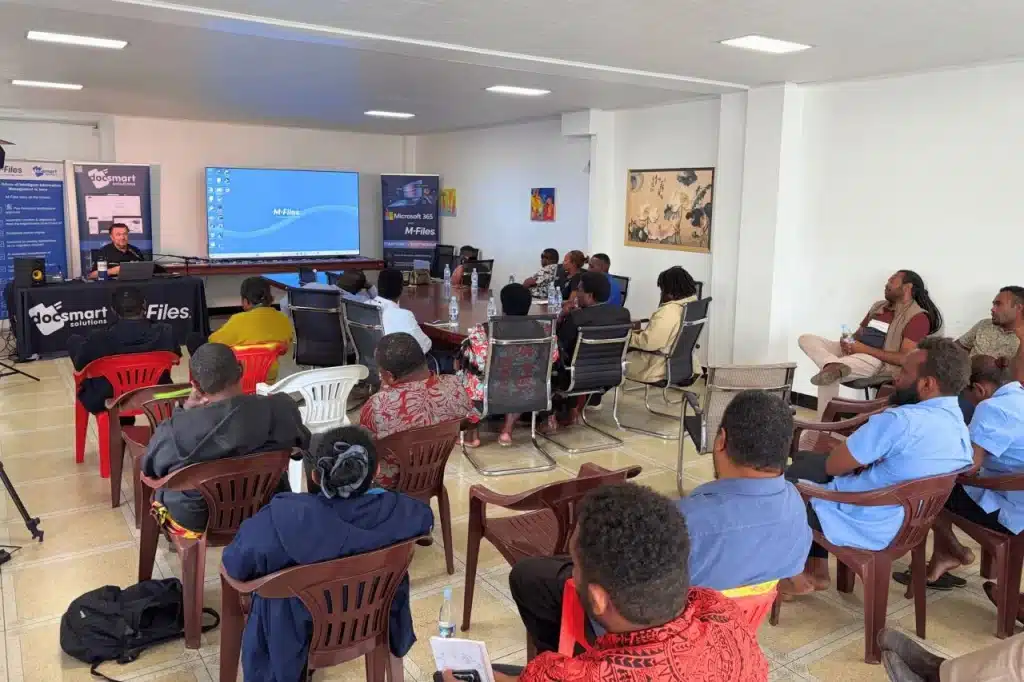
The Ministry of Lands & Natural Resources project tells a compelling story. But DocSmart’s work with M-Files in Vanuatu has the potential to extend beyond a single ministry. During a recent visit to Vanuatu, DocSmart brought together representatives from multiple government ministries and departments to hear directly about the Ministry’s journey and see M-Files in action.
The visit wasn’t simply about demonstrating software. It was about showing other government organisations what has already been achieved, with real numbers, real challenges, and real outcomes, and opening a conversation about what better information management could make possible for them. The turnout was strong, and the conversations that followed reflected genuine interest from organisations facing similar information challenges.
Many of those organisations share recognisable pain points. Unsupported legacy systems that have become difficult to rely on. Lingering concerns about digital security following the 2022 cyberattack. Physical records that became vulnerable during and after the 2024 earthquake. Staff vacancies that make every inefficiency more costly than it would otherwise be. The Ministry of Lands & Natural Resources story resonates because it isn’t abstract. It’s a real response to real conditions that other Vanuatu government bodies understand from their own experience.
DocSmart’s intention is to continue growing the conversation about M-Files across the Vanuatu Government, building on what the Ministry has already demonstrated and helping more organisations understand what’s genuinely achievable with the right platform and the right implementation partner.
It would be easy to tell this story purely as a technology story. New system replaces old system. Digital replaces paper. Problem solved. But that framing misses the point of what’s actually happening at the Ministry of Lands & Natural Resources.
The Ministry hasn’t suddenly gained unlimited staff. Demand for its services hasn’t disappeared. The land titles still need to be processed, the records still need to be maintained, and the organisation still needs to operate effectively under real-world constraints. What M-Files has changed is how much useful work the same people can accomplish with the information they already have.
Less time searching through boxes. Less time chasing approvals through manual processes. Less time re-entering information that already exists somewhere in the system. More time for the work that genuinely requires expertise, judgement, and human decision-making. That’s the real outcome, and it’s the outcome that matters most to the people doing the work every day.
DocSmart is a Premier Elite M-Files Partner, and we know what it takes to make an implementation like this work in practice, not just in theory. The Vanuatu project reflects the kind of hands-on, context-specific approach we bring to every engagement. Whether the challenge is a government ministry managing hundreds of thousands of land records or a private organisation grappling with growing document volumes, the core question is always the same: how do we help people do more with the information they already have?
If your organisation is facing similar challenges with growing volumes of information, talk to the friendly DocSmart team about how M-Files could help.
M-Files is an information and document management platform. DocSmart has implemented M-Files for Vanuatu’s Ministry of Lands & Natural Resources to help recover existing digital records, digitise physical documents, connect information with existing data, and introduce more efficient digital workflows.
DocSmart migrated more than 150,000 documents from the Ministry’s legacy Saperion system into M-Files, making them searchable and accessible to staff. In addition, more than 11,000 physical documents had been scanned and processed into the system at the time of the most recent project update, with the digitisation programme continuing.
M-Files includes a built-in AI assistant called Aino, which analyses documents as they are scanned and suggests appropriate metadata such as document type, title reference, and date. Staff review and confirm Aino’s suggestions before documents are saved, keeping human oversight in the process while significantly reducing manual classification work.
Yes. DocSmart recently hosted a government-wide event in Vanuatu to share the Ministry of Lands & Natural Resources story and demonstrate M-Files to representatives from other ministries and departments. The conversations that followed reflected strong interest, and DocSmart is actively continuing those discussions across Vanuatu government.
M-Files is recognised globally as a leading document management platform, most recently being named a Leader in the 2026 Gartner® Magic Quadrant™ for Document Management. Its ability to connect documents with enterprise data, automate workflows, and support AI-assisted classification makes it particularly well suited to government organisations managing large volumes of complex, interconnected records.

© 2026 DocSmart All Rights Reserved l Privacy Policy | Terms & Conditions | Web Design by Virtual Innovation