
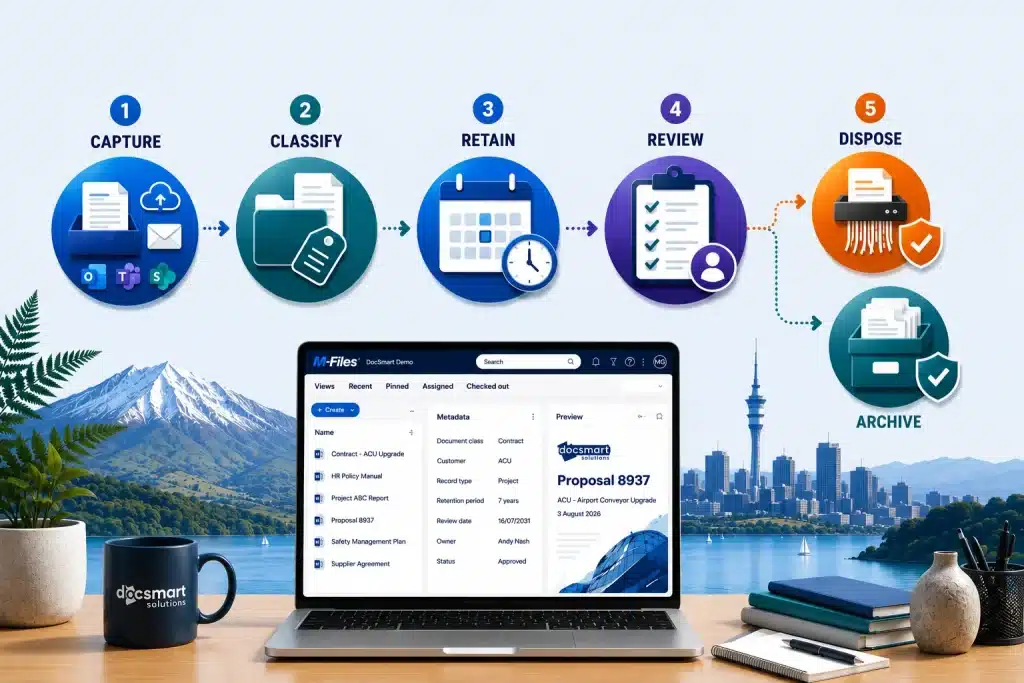
Most Kiwi organisations share the same instinct when it comes to records: if in doubt, keep it. It feels like the safe option. But as document volumes grow into the hundreds of thousands, that ‘keep everything forever’ approach creates its own risks, costs, and compliance headaches. Proper document retention NZ practice is not simply about holding onto files. It is about knowing what you have, how long to keep it, when to review it, and how to dispose of it correctly when the time comes.
This guide breaks down what document retention and disposal actually means in a New Zealand context, why scattered systems make it so hard to manage, and how the right tools and processes can bring everything under control.
Think of your document storage like a shed. At first, it makes sense to hang onto things just in case. But over time, without a system for what goes in and what goes out, the shed fills up. Finding anything becomes a project in itself, and half of what is in there probably should have been cleared out years ago.
For organisations managing hundreds of thousands of documents across multiple systems, this is exactly what happens. Storage costs climb, search results become unreliable, and when an audit or legal matter arises, proving what you have and what you disposed of becomes far harder than it should be. Document retention NZ compliance is not just a records management concern. It directly affects legal risk, privacy obligations, and operational efficiency.
Retaining records beyond their required period also creates privacy risks. Under the Privacy Act 2020, organisations are expected to not hold personal information longer than necessary. Keeping everything indefinitely can actually put you in breach, not protect you from it.
Document retention refers to the practice of keeping records for a defined period based on their type, legal requirements, and business value. Disposal is the controlled process of removing or destroying records once they have passed their retention period and been approved for disposal.
In New Zealand, Archives New Zealand provides guidance on retention and disposal requirements for public sector organisations through the Public Records Act 2005. For private sector businesses, retention obligations come from a range of sources including the Companies Act, the Tax Administration Act, employment law, and industry-specific regulations. Knowing which rules apply to which records is the starting point for any document retention NZ framework.
A solid document retention NZ process involves three stages. First, records are assigned a retention period at the point of creation or capture. Second, when that period expires, records enter a review stage where someone with appropriate authority confirms whether disposal is appropriate. Third, disposal is carried out and documented, with an audit trail showing who approved it and when.
This is not about deleting things carelessly. Controlled disposal is a deliberate, documented action. It protects the organisation by demonstrating that records were managed according to policy, rather than lost, accidentally deleted, or buried under years of digital clutter.
Most Kiwi organisations have documents spread across more systems than they realise. Microsoft Teams conversations with attachments, files in SharePoint, project folders on shared drives, contracts in email inboxes, and forms saved to desktop folders. Each of these holds records, and none of them talk to each other about how long those records should be kept.
Applying a consistent document retention NZ policy across all of these systems is genuinely difficult. SharePoint can hold retention labels, but they depend on people applying them correctly. Email archiving is inconsistent across staff. Shared drives have no native retention or disposal functionality at all. When a retention review is due, how do you find the right records across five different platforms?
Even with a written retention policy in place, the reality is that people apply it inconsistently. One team member follows the policy carefully. Another keeps a local copy ‘just in case’. A third doesn’t know the policy exists. Over time, this creates a patchwork of retained and abandoned records with no reliable way to demonstrate compliance.
For organisations with hundreds of users working across multiple locations, this inconsistency compounds quickly. The result is a document retention NZ nightmare: thousands of records of unknown age, unknown ownership, and unknown status scattered across platforms that were never designed to manage information governance.
A document retention policy is only as useful as the detail it contains. A vague policy that says ‘keep financial records for seven years’ without specifying which records, who owns them, or how disposal is approved is not going to hold up under scrutiny. A good document retention NZ policy covers several key areas.
Record types should be clearly defined. Tax invoices, employment contracts, health and safety records, project files, correspondence, and client agreements all have different retention requirements. Each should be listed with a specific retention period drawn from the relevant legislation or regulatory guidance that applies to your organisation.
Ownership matters too. Every record category should have a designated owner who is responsible for ensuring records in that category are managed correctly. Without ownership, nothing gets done when a retention review is due. The policy should also define the approval process for disposal, including who can authorise it and what evidence must be kept to demonstrate that approval was given.
One of the most overlooked elements of document retention NZ compliance is the audit trail. If you cannot show who approved a disposal decision, when they approved it, and what records were disposed of, you cannot demonstrate that your disposal was controlled and intentional. This matters enormously in legal disputes, regulatory audits, and privacy investigations.
Good audit evidence does not have to be complicated. A structured workflow that records every action taken against a document, from creation through to disposal, gives you exactly what you need. The challenge is that this kind of audit trail is very hard to maintain manually, particularly across large volumes of records.
Here is where things get practical. The reason document retention NZ policies are hard to enforce consistently is that people struggle to identify what a document is at the point of saving it. If a file is named ‘Invoice_March_v2_final_FINAL.pdf’ and saved to a general folder, there is no structured information attached to it that would allow a system to know its type, its owner, or when its retention period begins.
Metadata changes this. When a document is captured into a system like M-Files, it is tagged with structured information: document type, client or project reference, creation date, responsible department, and any other relevant attributes. This is not just for search purposes. It is the foundation of automated retention management.
Once a system knows that a document is a ‘contractor agreement’ created on a specific date, it can automatically calculate when the retention period for that document type expires and flag it for review at the right time. Classification makes retention consistent because it removes the reliance on individual memory and judgement.
For larger organisations managing complex information environments, understanding how classification fits into a broader governance framework is important. Our article on Enterprise Document Management Solutions: What Growing NZ Organisations Actually Need explores this in more detail.
M-Files handles document retention NZ requirements by combining metadata, automated workflows, and a full audit trail into a single platform. Rather than relying on staff to remember when records are due for review, M-Files uses the metadata attached to each document to trigger retention workflows automatically.
When a retention period expires, the relevant document owner receives a notification to review the record. They can then confirm disposal is appropriate, escalate for additional approval if required, or extend the retention period if there is a legitimate reason to do so. Every action is recorded automatically, giving organisations the audit evidence they need without any additional administrative effort.
Disposal in M-Files does not have to mean permanent deletion immediately. Records can be moved to a secure disposal queue, held for a final approval step, and then either destroyed or archived depending on the organisation’s requirements. For public sector organisations working within Archives New Zealand disposal authority frameworks, this structured approach aligns directly with what those frameworks require.
Automation does not mean removing human judgement from the process. M-Files workflows are designed to bring the right information to the right person at the right time, while ensuring that disposal decisions always involve an appropriate level of human review. This is important for document retention NZ compliance because regulators and courts want to see that disposal was a deliberate decision, not an automated deletion with no oversight.
DocSmart is a Premier Elite M-Files Partner, helping New Zealand organisations improve document and information management. We work with councils, engineering firms, insurance brokers, law firms, and government agencies to design retention and disposal frameworks that work in practice, not just on paper. If you are looking at how document control fits into this picture, our guide to Document Control Software NZ: The Smart Way to Manage Your Business Documents is a good place to start.

It is not always obvious that a document retention NZ process has broken down. Here are some practical warning signs that suggest it is time to take a closer look at how your organisation manages records.
You are keeping everything indefinitely. If the default approach in your organisation is to never delete anything because ‘storage is cheap’, you are accumulating risk alongside those files. Privacy obligations, legal discovery obligations, and the sheer volume of noise in your systems all grow with every record you hold beyond its useful life.
Disposal is inconsistent or informal. If records are being deleted by individuals without any formal approval process, you have no way to demonstrate that disposal was intentional and authorised. Equally, if nobody is deleting anything at all, your retention policy exists only on paper.
You cannot answer basic questions about your records. If someone asked you right now how many contracts from three years ago are still held in your systems, could you answer accurately? If not, your document retention NZ framework needs some work.
Your systems do not talk to each other. If retention information lives in a spreadsheet but the records live in five different platforms, enforcing that retention schedule consistently is practically impossible. The gap between the policy and the reality is where compliance risk lives.
You have no audit trail for past disposal decisions. If records have been deleted but there is no log of who approved it, when, and why, you cannot demonstrate controlled disposal. In a legal or regulatory context, this looks much worse than having a documented process, even an imperfect one.
Under the Tax Administration Act, most financial records in New Zealand must be retained for a minimum of seven years. This includes invoices, receipts, bank statements, and tax returns. Some records may have longer requirements depending on the nature of the transaction or the industry you operate in.
There is no single law that requires all NZ businesses to have a written retention policy, but multiple pieces of legislation impose specific retention obligations on different record types. Having a documented document retention NZ policy demonstrates that your organisation has understood and addressed those obligations, which matters significantly in the event of an audit or dispute.
Controlled disposal means that records are only destroyed or removed after a formal review and approval process, with the decision and the approver documented. It is the opposite of informal deletion. Controlled disposal gives organisations evidence that records were managed intentionally, which is important for regulatory compliance and legal defensibility.
Yes. Platforms like M-Files use metadata and automated workflows to track retention periods, trigger reviews when records are due for disposal consideration, and record every approval action in an audit trail. This makes document retention NZ compliance far more consistent and manageable, particularly for organisations holding hundreds of thousands of records across multiple systems.
Yes. Public sector organisations in New Zealand are subject to the Public Records Act 2005 and must comply with disposal authorities issued by Archives New Zealand before destroying any public records. Private sector businesses are governed by a range of other legislation depending on their industry and the types of records they hold, but the core principles of retention, review, and controlled disposal apply across both sectors.
Document retention NZ is one of those areas where the gap between what organisations think they are doing and what is actually happening can be surprisingly large. The good news is that with the right framework, the right metadata strategy, and the right tools, retention and disposal can become a routine, reliable process rather than a source of ongoing risk.
At DocSmart, we know that every organisation’s information environment is different. Whether you are starting from scratch or looking to improve an existing approach, our team is ready to help you build a document retention NZ process that works in practice. Get in touch with the DocSmart team today and let’s talk about what good looks like for your organisation.

© 2026 DocSmart All Rights Reserved l Privacy Policy | Terms & Conditions | Web Design by Virtual Innovation